
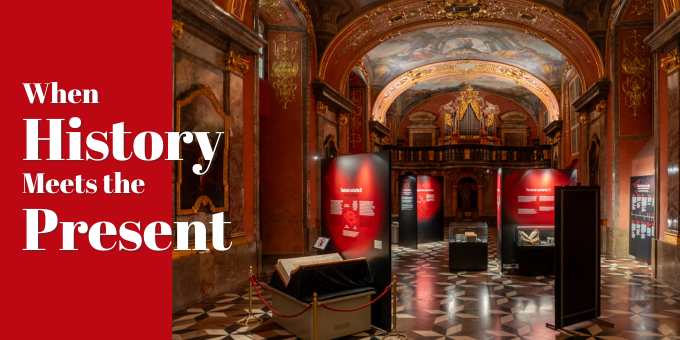
A Heritage Space, Reimagined With Freestanding Exhibition Walls
When working with a historic space, the goal is not always to “transform” the room. It is to add an exhibition layer that respects the space's architecture, enhances the visitor experience, and does not require permanent changes to the building.
The following example from the Prague National Library exhibit (shown in the photos below) shows how a temporary exhibition can feel intentional within a historic space. Instead of trying to overpower the architecture, the design introduces a clear visual framework that helps visitors understand the story, move through the room naturally, and focus on the artifacts.
Key Takeaways
- Freestanding walls create a well-defined, modern exhibition layer while preserving the architectural integrity of heritage venues.
- Strategic use of panels, corners, and focal points guides visitor flow naturally, without permanent changes to the building.
- Systems like Mila-wall allow custom configurations and are reusable across multiple exhibits, reducing future setup time and cost.
- High-contrast backgrounds and consistent graphics help visitors focus on key messages, even in visually rich, ornate rooms.
Quick Links
- About the Exhibition
- Design Highlights of this Exhibition
- How Mila-Wall Integrates Into This Kind of Exhibition
- Thinking About a Similar Project In Canada?
About the Exhibition
The Prague National Library exhibit, titled KOSMAS 900, was created to mark the 900th anniversary of the death of the chronicler Kosmas. It brought together almost all surviving medieval manuscripts of his chronicle, with works dating from the 12th to the 17th centuries and loans from European libraries. One notable highlight was the Leipzig manuscript, which contains the only surviving illustration of the author.
The exhibition was presented by the National Library of the Czech Republic in the Klementinum in Prague, specifically in the Baroque Mirror Chapel, a historic setting that adds its own atmosphere and visual character to the visitor experience.

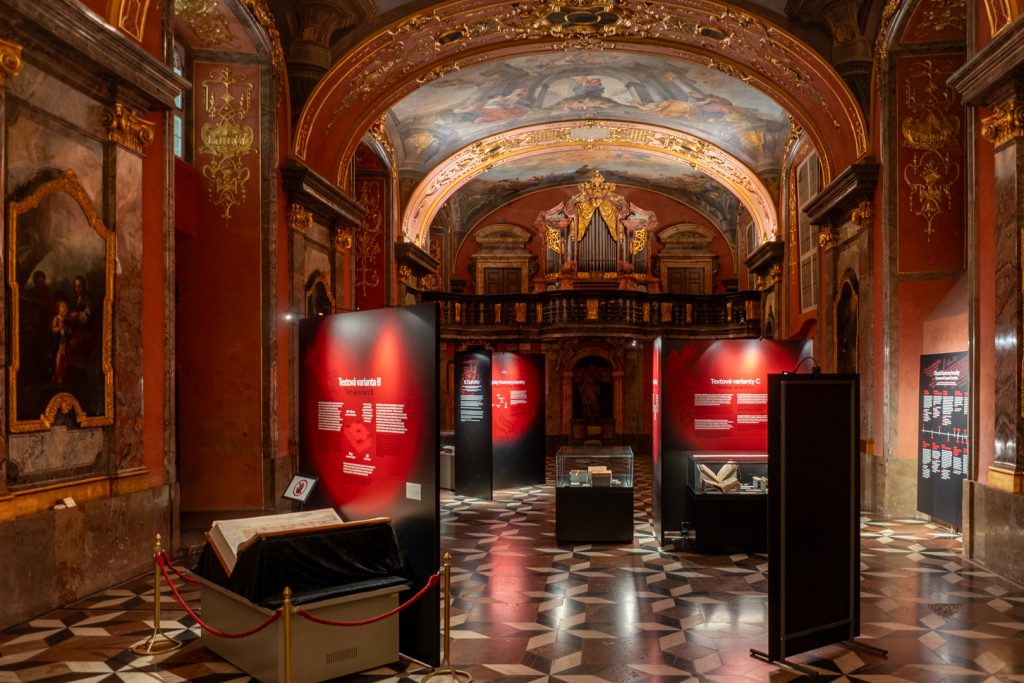
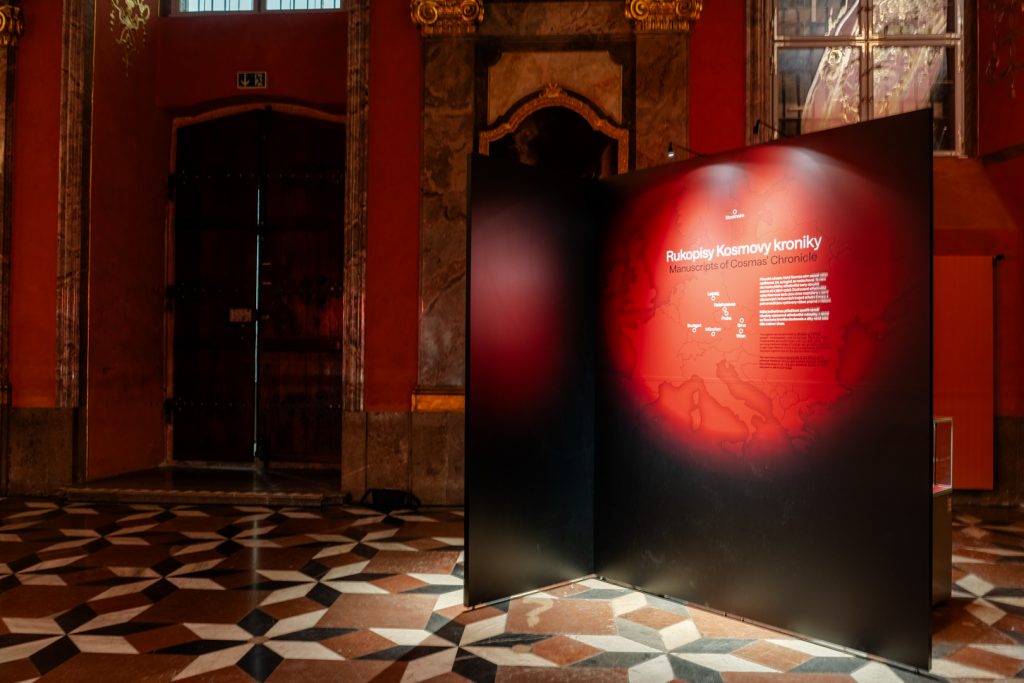
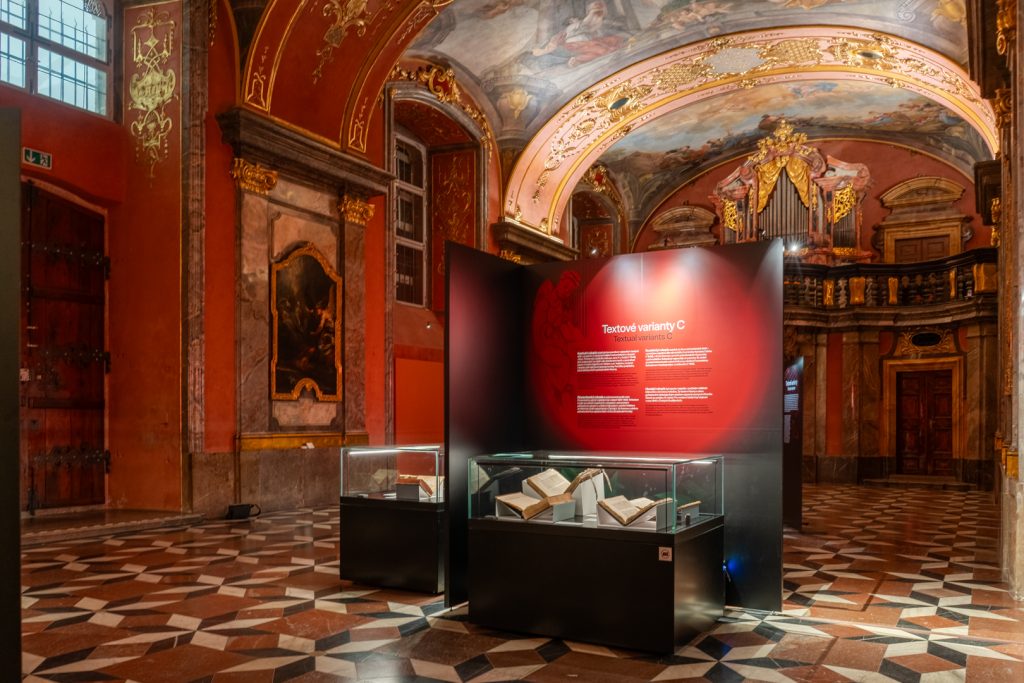
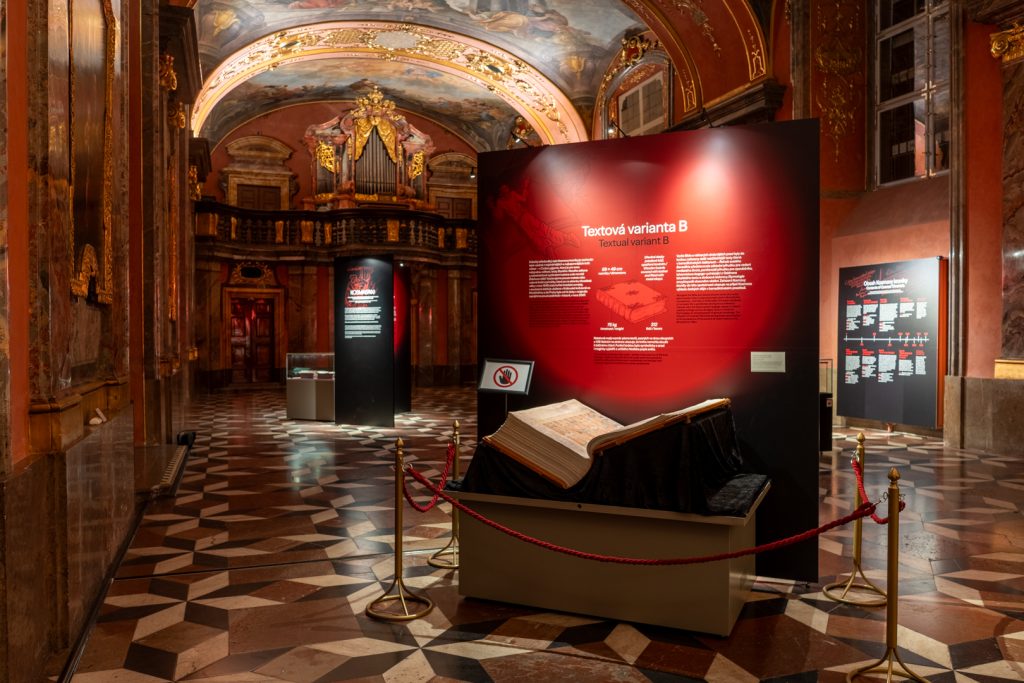
All images are under the following copyright: National Library of the Czech Republic “Exhibition KOSMAS 900, 2025”
Design Highlights of this Exhibition
What makes this specific exhibition design work so well is that it creates a modern, readable experience within a highly ornate room without competing with it. The freestanding exhibition wall system introduces a simple “exhibition layer” that supports content with a consistent backdrop. This approach allows visitors to clearly follow the storyline, even in a visually rich heritage setting.
You can see a deliberate use of contrast throughout the space. The dark wall surfaces reduce visual clutter and help the interpretive content stand out, while bold graphic elements on red backgrounds act as strong orientation points. This makes key messages easy to catch at a distance and helps establish a natural rhythm as visitors move from one section to the next.
The layout also does more than display information. It defines the visitor journey. Panels, returns, and corners create distinct zones, guide sightlines, and gently direct circulation without the need for permanent barriers. Display cases are positioned as focal anchors, while the walls support the narrative around them, resulting in a coordinated experience where artifacts and interpretation feel intentionally connected.
How Mila-Wall Integrates Into This Kind of Exhibition
Although Hunter Expositions was not involved in this project, I am sharing it to illustrate the types of outcomes that can be achieved with the modular, freestanding Mila-wall system, especially in heritage venues and public spaces where permanent construction is not an option.
Here is how Mila-wall fits particularly well in environments like this.
1. Free-Standing Zoning Without Touching the Building
In heritage interiors and many public spaces, you often want to avoid attaching anything to walls, columns, or decorative finishes. A free-standing system lets you create defined exhibit zones and routes while keeping the building intact.
2. A Clean, Graphic-Ready Surface
Smooth, uniform wall surfaces provide curators and designers with an ideal backdrop for typography, maps, timelines, and object labels, particularly in rooms where the architecture already carries strong visual character.
3. Layout Flexibility
Many exhibits require more than a straight line of panels. You may need corners that redirect sightlines, islands that slow visitors down, and short returns that support pacing. A modular system supports these layouts and makes it easier to adjust as the exhibit takes shape.
4. A Calm Backdrop That Protects the Experience
In visually rich rooms, the walls are not trying to “win.” Their job is to quiet the environment, frame the content, and let visitors focus on the story and the objects.
5 Takeaways You Can Apply to Your Exhibit
Every venue is different, but the principles that make an exhibition successful are surprisingly the same. If you’re planning a show in a museum, gallery, library, or public space, here are five elements you can apply early in the design process.
- Use contrast intentionally. A contemporary layer can improve clarity without fighting the architecture.
- Let walls manage sightlines. A small corner or return panel can make a space feel instantly more legible.
- Design around pause points. Plan where visitors will naturally stop so the flow stays comfortable.
- Respect the building while elevating the story. The goal is not to hide the venue, it is to create a better exhibition experience inside it.
- Plan for reuse. A modular approach helps you reuse wall components across future exhibits, reducing rebuild costs and shortening turnaround time.
Thinking About a Similar Project In Canada?
If you are planning an exhibit in a museum, gallery, historic, or public space, and you want a wall solution that supports museum-style exhibitions while staying flexible, I will be happy to help you think through the configuration, the layout logic, and what will make sense for your venue and your programming.
Reach out to Hunter Expositions to discuss your space and your exhibition goals.
Note: Hunter Expositions did not design or install the exhibition shown in these photos. I am sharing it as a Mila-wall provider in Canada to illustrate the types of results freestanding, moveable gallery walls can deliver in real heritage and public environments.