
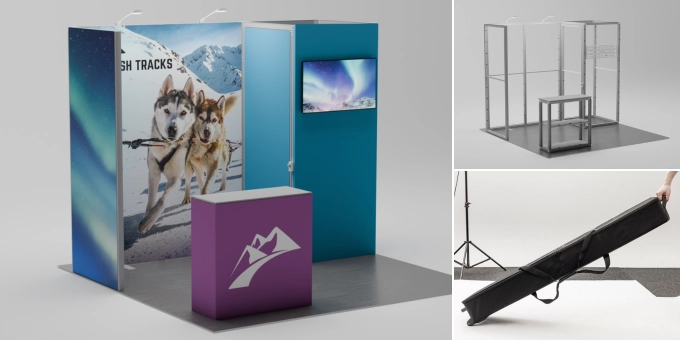
Buying a 10' x 10' Trade Show Booth: What to Consider
A 10' x 10' trade show booth is often the first significant investment a company makes when it begins exhibiting at trade shows. This booth size provides enough space to showcase a company and its products and to meet potential customers without incurring the cost and complexity of a larger exhibit.
As with most things, there are many options on the market. If you are wondering how to choose a 10' x 10' trade show booth, start by thinking about how you plan to use it. First-time exhibitors often focus on the booth's appearance and the initial price, which is understandable. However, there are many other factors you will quickly come to appreciate once you start attending trade shows.
Key Takeaways
- Choose a 10' x 10' trade show booth based on how you plan to use the space, including product demonstrations, visitor meetings, storage needs, transportation, and whether you may expand to a larger booth later.
- The booth wall system should balance portability, durability, stability, ease of setup, and reusability.
- Fabric weight matters, but print quality, colour reproduction, wrinkle resistance, fit, and lighting are also important.
- Consider what happens before and after each show, including how the booth packs, how graphics and components are protected, where everything will be stored, and who will handle maintenance and inventory checks.
- Buying can make sense for companies that exhibit frequently with consistent needs, while renting offers more flexibility for first-time or occasional exhibitors.
Quick Links
- Define How You Will Use Your Trade Show Booth
- Choose the Right Booth Wall System
- Pay Attention to Fabric and Print Quality
- Don't Forget Storage and Maintenance
- Keep Your Booth Practical
- Should You Buy or Rent Your First 10' x 10' Trade Show Booth?
- Conclusion
Define How You Will Use Your Trade Show Booth
Before looking at booth systems, fabrics or accessories, think about what actually needs to happen inside your booth. Will you mainly use it to meet people and introduce your company, or will you also be demonstrating a product? Your requirements can vary considerably depending on how you plan to use the space.
For example, if your booth is mainly intended to build brand visibility, you may only need a sturdy backwall, a counter, and enough open floor space to speak with visitors. On the other hand, if you plan to display equipment or products, you may need a counter, shelving, or storage space.
There are also a few things to consider beyond the booth itself:
- How many trade shows will you attend each year?
- Will your employees be in charge of your booth setup?
- Will you ship the booth or transport it yourself?
- Will you always have a 10' x 10' exhibit space?
- Do you think you may eventually move up to a 10' x 20' space?
Generally, I recommend starting with what you need now. If you invest in a good system, you can always add components later. There is little advantage to buying extra pieces that your team will have to transport, store, and manage if you are not actually using them.
Choose the Right Booth Wall System
While the visual appearance of your booth is very important, the structure behind it matters just as much. From a practical standpoint, the frame affects the booth's weight, how easy it is to set up, pack, and transport, and how well it can adapt as your needs change.
If you plan to transport and set up your own trade show booth, I strongly recommend paying close attention to the system's design before making a decision.
Here are five important factors to consider when selecting your trade show booth system.
1. Portability
If you expect to attend several trade shows, you will appreciate having a booth that is easy to move. Modular aluminum systems are worth considering because they are generally lighter and easier to transport and handle.
However, not all aluminum frame systems offer the same level of portability.
A good example is a tubular aluminum pop-up frame. These systems fit easily into carrying bags and are practical to transport by car. However, they typically offer a more limited level of durability and flexibility.
Then there are other systems such as Looboo. Depending on the booth's size, they can be transported by car or courier. They are also made of aluminum but provide a more substantial structure you can build on over time, while remaining relatively easy to assemble.
Since a trade show booth may be packed, shipped, assembled, dismantled, and repacked many times, I would add that it is equally important to choose a system that is both portable and durable.
2. Ease of Setup
Ease of setup is another important consideration, particularly when your budget is limited. As you compare systems, ask yourself the following questions:
- How many people are required to set up the booth?
- Can the system be assembled without tools?
- How many pieces are there?
- Are the frame components clearly identified?
- How are the graphics attached?
- How long does setup normally take?
A booth system that can be assembled quickly by one or two people, with few or no tools, is a definite advantage if you are new to trade shows. It can also help you save on installation costs, which are often associated with more sophisticated systems.
3. Reusability
If your exhibiting needs are likely to change over the next few years, take a close look at how flexible the booth system is.
For example, you may start with a 10' x 10' booth and expand to a 10' x 20' booth a few years later. With the right modular system, you can reuse much of what you already own and simply add frames, graphics, or other components.
4. Stability
Even a lightweight 10' x 10' trade show booth should be stable once it is assembled. You do not want your backwall moving every time a visitor brushes against it or a monitor feeling unstable during the show.
How a booth is stabilized varies from one system to another. Some use feet, baseplates, connectors, returns or, when necessary, additional weights.
The booth configuration also matters. A simple 10-foot backwall does not require the same support as a structure with shelving, monitors, a counter or other attached elements.
Find out how your booth will be stabilized in the configuration you are considering. It is an easy detail to check before you buy and a much less pleasant one to discover once you are at the show.
5. Ease of Packing and Transportation
When buying a 10' x 10' booth, it is just as important to look at how the system comes apart and packs away.
At the end of a trade show, your team is tired, and everyone on the show floor is dismantling at the same time. You want to be able to pack your booth without having to figure out where every piece belongs.
Look at the type of carrying bag, protective cover, or transport case supplied with the system. Does everything fit easily? Are the different components properly protected? Can the graphics be packed without creasing or damage?
Some carrying cases can even be converted into counters. This can be particularly practical for a 10' x 10' booth: you are already transporting the case, and once you arrive, it becomes a useful part of your exhibit.
If possible, ask to see how the entire booth packs before buying it. You will have a much better idea of what your team will actually need to transport and handle.
Pay Attention to Fabric and Print Quality
Fabric weight is one of the criteria that frequently comes up when comparing portable trade show booths. For example, one supplier may offer 230 g/m² fabric while another uses a lighter material. It is an important factor, but it should not be the only one.
Look at the print quality, colour reproduction, wrinkle resistance, and how well the fabric fits once installed on the frame.
Remember that your booth graphics will be viewed under exhibition hall lighting, not on the computer screen where they were designed. Some colours, particularly darker shades, gradients and skin tones, may look different once printed.
When comparing fabric graphics, look at:
- Fabric weight and quality
- Print quality and resolution
- Colour reproduction
- Wrinkle resistance
- How well the fabric fits the frame
- Ease of installation and removal
- Whether replacement graphics can be ordered without replacing the frame
If accurate brand colours are non-negotiable, it may be worth requesting a printed proof or test before producing the final graphics.
Lighting should also be considered when designing the graphics. Artwork for a backlit display is prepared differently from graphics used on a standard fabric wall. Lighting can also affect contrast and how colours are perceived.
Don't Forget Storage and Maintenance
If you buy your booth, you will need somewhere to store it between shows.
A small portable booth may fit into a few bags or cases. A more elaborate system with a counter, lighting, shelving, flooring, and other accessories will obviously require more storage space.
You should also plan for some basic maintenance.
After each show, someone should check that all the pieces came back and that the graphics were packed correctly. If components or connectors are damaged or anything is missing, those issues should be dealt with as soon as possible. These are simple steps, but they can help you avoid unpleasant surprises the next time you set up.
If you exhibit frequently, keep in mind that companies specializing in the design, sale, and installation of trade show booths, such as Hunter Expositions, may offer turnkey services that include storage. These services should be factored in from the beginning when comparing your options.
Keep Your Booth Practical
A 10' x 10' booth covers 100 square feet. On paper, that may sound like a lot of space, but it fills up quickly. Add a counter, a monitor, two sales representatives, a few product samples, and two or three visitors, and circulation already starts to get tight.
Avoid trying to fill every square foot.
The same applies to your graphics. Your backwall does not need to explain everything your company does. It should help someone walking past your booth quickly understand who you are and what you offer. More detailed information can come through a conversation, demonstration, brochure, video, or QR code.
We have written an article explaining how to maximize space in a small trade show booth without overcrowding it. Take a look for more practical trade show tips.
Should You Buy or Rent Your First 10' x 10' Trade Show Booth?
You do not necessarily have to buy your first trade show booth.
If you attend several trade shows each year and your needs remain fairly consistent, purchasing can be worthwhile. You can reuse the frame, change the graphics as your messaging evolves, and add components over time.
Trade show booth rental may be worth considering if:
- You are attending your first trade show
- You only exhibit occasionally
- You want to test a new market
- Your exhibit space changes in size from one event to another
- You need a different configuration for a particular show
- You do not want to manage booth storage
There is also another very practical advantage to renting when you are just getting started: your first show gives you a chance to see what actually works.
You may realize that the counter was in the wrong location, that you had too much furniture, or that you did not have enough storage. Maybe the monitor attracted so many visitors that it ended up blocking part of the booth.
There is a lot to be said for testing what works before investing in a booth you expect to use for several years.
Conclusion
When you are getting ready to buy a trade show booth for the first time, it is easy to focus mainly on appearance and price. I recommend looking well beyond those two factors and considering the system as a whole: its frame, ease of setup, stability, transportation, graphic quality, and its ability to adapt as your needs change.
If you decide to buy, also think about what happens between shows: where the booth will be stored, who will look after it, and what condition it will be in when it arrives at the next event.
After more than 40 years of working closely with exhibitors, I have seen every type of booth, from very simple trade show displays to elaborate exhibits. The ones that work best are not necessarily the biggest or most complicated. What matters is that your booth meets your needs and helps you achieve your objectives.
If you are preparing for your first trade show, we can help you choose the right 10' x 10' trade show booth. We offer a range of options, from portable displays and modular structures to custom designs, based on your requirements and budget. We also offer both trade show purchase and trade show booth rental options. Contact our team for more information.